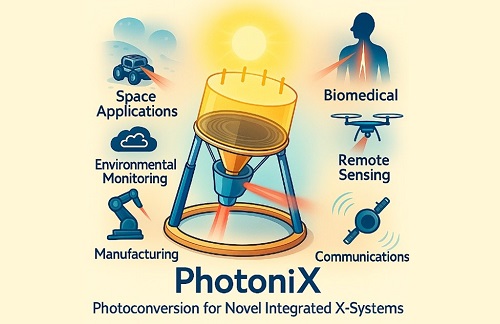
The coordinator of the project PHOTONIX – PHOTOconversion for Novel Integrated X-systems is The Cyprus Institute in Cyprus. Other partners include the Cypress company Lumoscribe Ltd, the Karlsruhe Institute of Technology in Germany, and ÚFE.
The PHOTONIX project aims to develop a completely new class of solar-powered fiber lasers that will directly convert concentrated solar radiation into coherent laser radiation in the mid-infrared region. Unlike existing approaches, which rely on electrical power, the project introduces a new concept in which solar energy directly powers photonic systems.
The research will focus on overcoming the main obstacles that have so far hindered the wider development of solar-powered lasers, such as efficiently coupling solar radiation into optical fibers, optimizing excitation dynamics, and ensuring the thermal stability of the system. Among other things, the goal is to develop:
- an adaptive optical system with sun-tracking capabilities,
- advanced multimode optical fibers for solar excitation,
- and the first demonstration of a continuous-wave solar-excited fiber laser in the mid-infrared region at practically usable power levels.
By combining expertise in concentrated solar power, photonics, and laser physics, the consortium aims to develop a compact prototype device at TRL 4 that will demonstrate the feasibility of high-performance photonic systems without the need for an electrical power supply.
The potential applications of the project’s results are wide-ranging—from space research to biomedicine, advanced manufacturing technologies, and remote sensing, all the way to next-generation telecommunications.
The PHOTONIX project was selected through an extremely competitive process under the EIC Pathfinder program, which supports visionary and high-risk research projects with the potential for significant technological impact. The success rate for selection was less than 2%, underscoring the scientific quality and innovative potential of both the project and the participating institutions.
(Intro image source: The Cyprus Institute)