


The Czech Academy of Sciences educational trail connects research facilities in Prague 8’s Ládví and Kobylisy neighborhoods and uses interactive exhibits to introduce the public to their research. The individual stops showcase various fields of physics, chemistry, computer science, and engineering. Visitors can not only read about the principles behind scientific phenomena on the information panels but, above all, try them out for themselves.
The trail was created as an open-air “science center” for families with children, schools, and all curious passersby.
The educational trail was officially opened on Friday, September 25, 2026, in front of the Institute of Physics of the Czech Academy of Sciences. The opening took place as part of Researchers’ Night and also featured a science show by the Amazing Theater of Physics. Learn more here.

Each facility presents a different scientific principle or area of research. Along the trail, visitors can encounter, for example, a Galton board, a flywheel, a model of an atom, or experiments related to viscosity, spectroscopy, or number systems. The trail also features a mural dedicated to Jaroslav Heyrovský, the only Czech Nobel Prize laureate in the natural sciences.
Stops along the educational trail:
- 0 – The Heyrovský and Nobel Mural
- 1 – Institute of Information Theory and Automation
- 2 – Institute of Computer Science
- 3 – Institute of Physics
- 4 – Heyrovský Institute
- 5 – Institute of Thermomechanics
- 6 – Institute of Plasma Physics
- 7 – Institute of Photonics and Electronics
ÚFE exhibit: How light stays on the right path
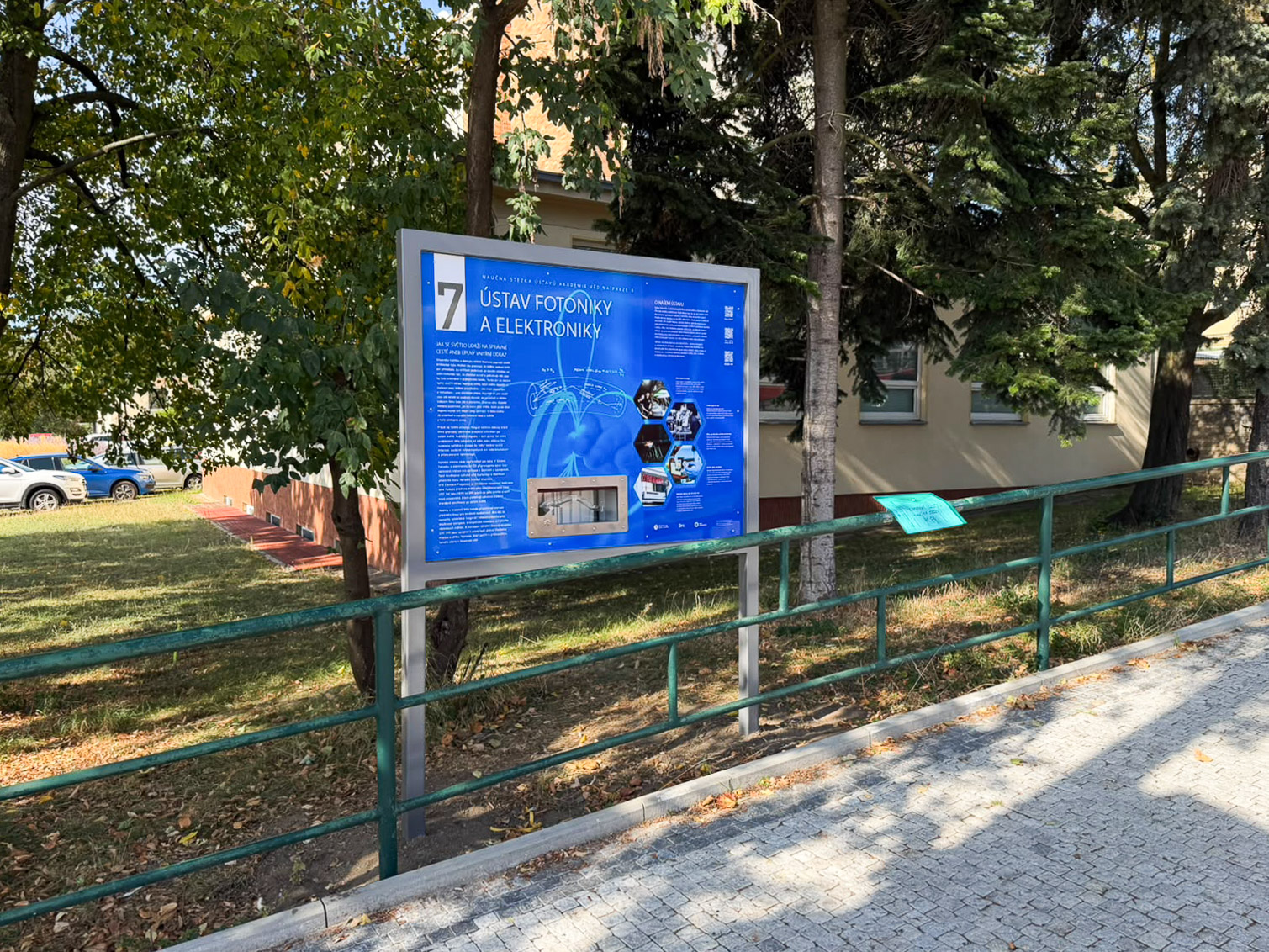
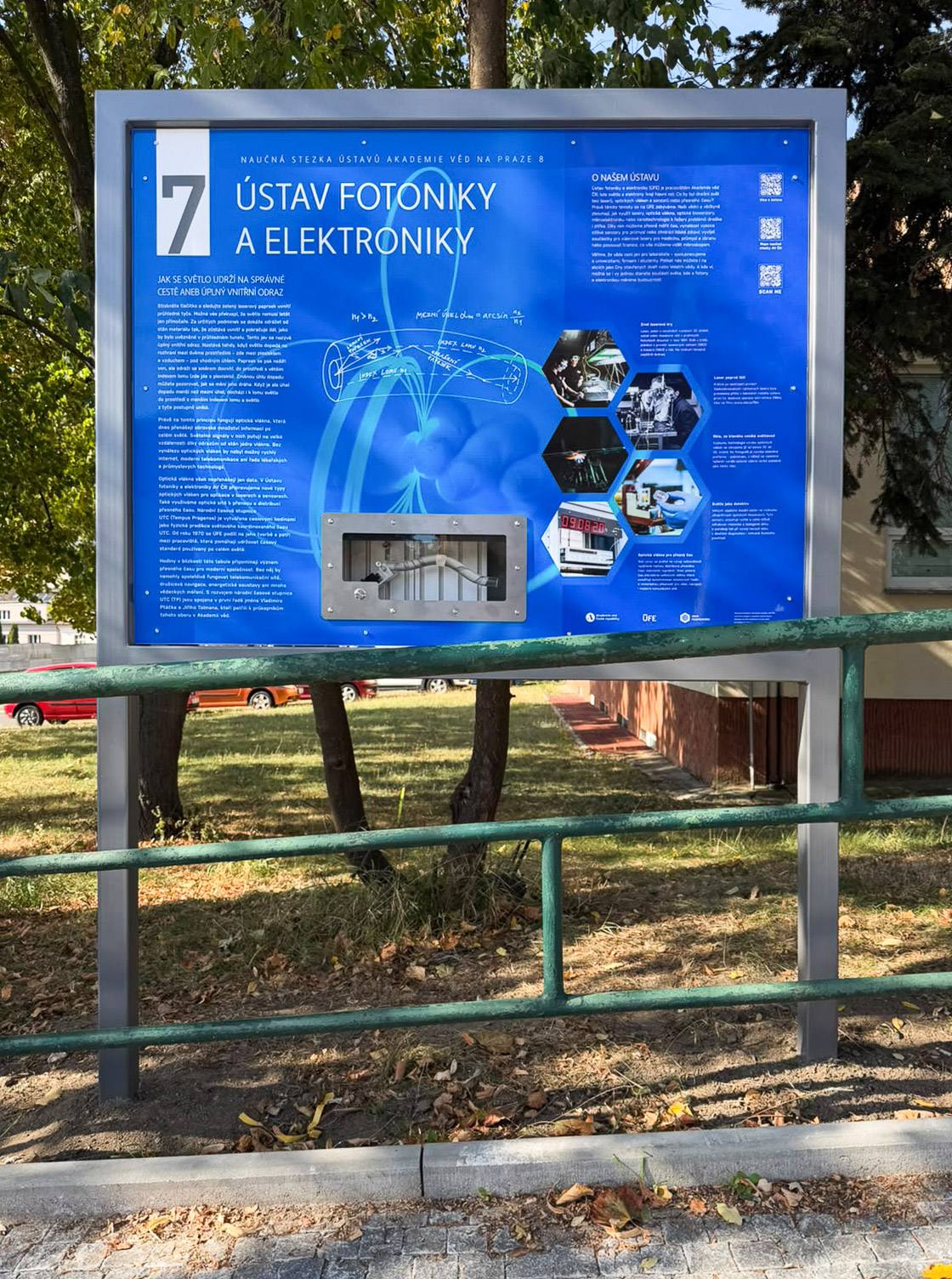
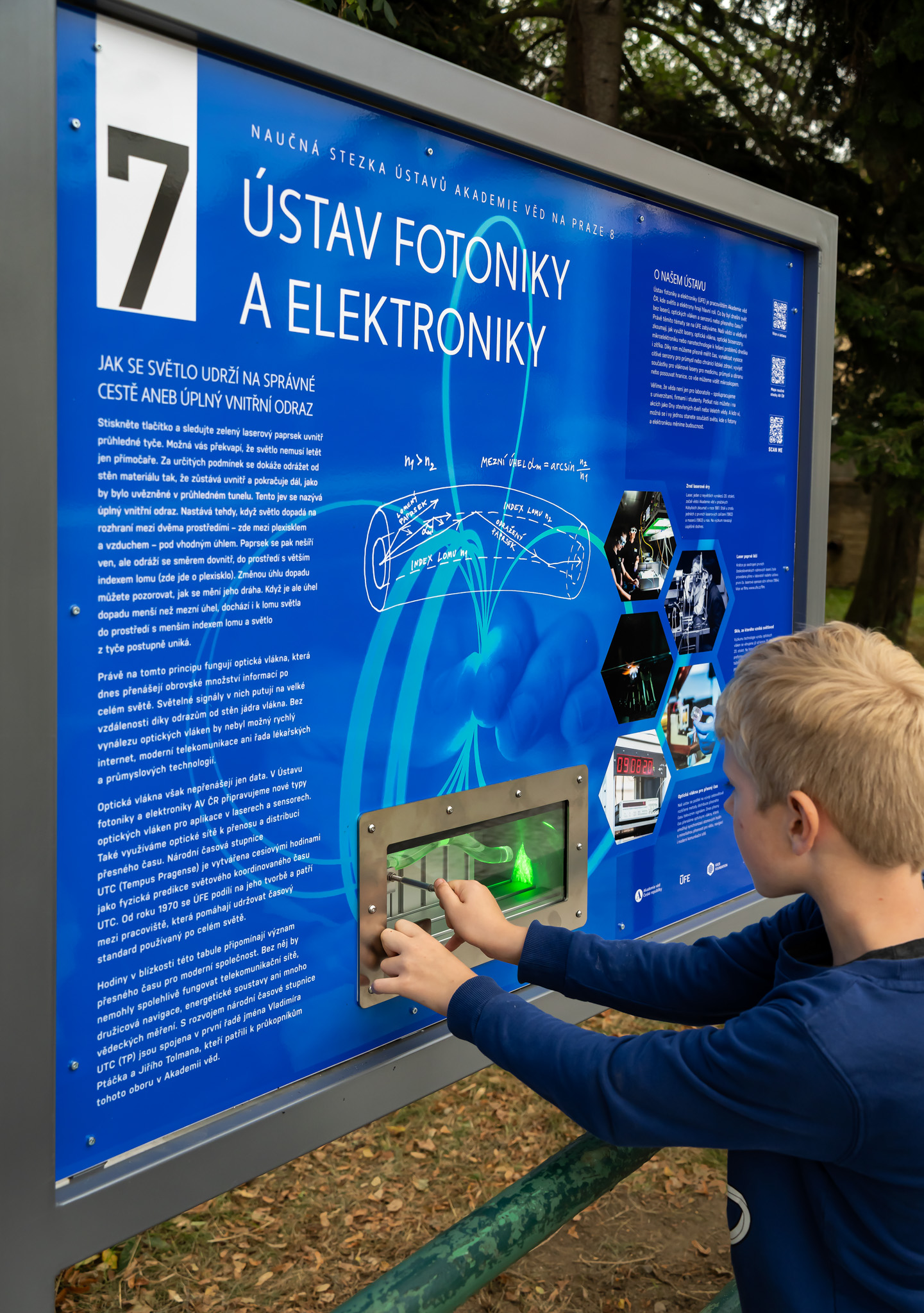
Stop No. 7 at the Institute of Photonics and Electronics of the Czech Academy of Sciences will take you into the world of photonics and optical fibers. Our interactive exhibit consists of a transparent Plexiglas rod and a green laser. When you press the button, you can change the direction of the light beam and watch its path inside the rod.
Under certain conditions, light does not escape from the material but is repeatedly reflected off its walls. This phenomenon is called total internal reflection. By changing the angle of the laser, you can observe how the path of the beam changes and when light begins to escape from the rod. Our exhibit demonstrates precisely this principle.

From plexiglass rods to optical fibers
Total internal reflection is one of the fundamental principles behind how optical fibers work. Thanks to this phenomenon, a light signal can remain inside the fiber and transmit information over long distances. Today, optical fibers are the backbone of high-speed internet and telecommunications, but they are also used in medicine, industry, sensors, and laser systems.
Optical fibers at ÚFE
Research into optical fibers has a long tradition at our institute. We have been working on the technology for their production since the late 1970s. Part of this process involves preparing a special glass preform – a semi-finished product from which the optical fiber itself is subsequently drawn. Today at ÚFE, we are developing new types of optical fibers, for example, for fiber lasers and optical sensors.
Precise time and optical networks
In the past, the Institute of Photonics and Electronics contributed to the development of a globally widespread method for distributing precise time via television signals. Today, optical networks can be used for the highly precise transmission of time and frequency signals.
Optical fibers make it possible, for example, to synchronize atomic clocks over long distances with exceptional precision. Such synchronization is important for science, navigation, and modern communication systems.
Since 1970, the Institute of Photonics and Electronics (ÚFE) has also been involved in the creation of the Czech national time scale UTC(TP) – Tempus Pragense. Accurate time is essential not only for scientific measurements but also for telecommunications networks, satellite navigation, and power systems.
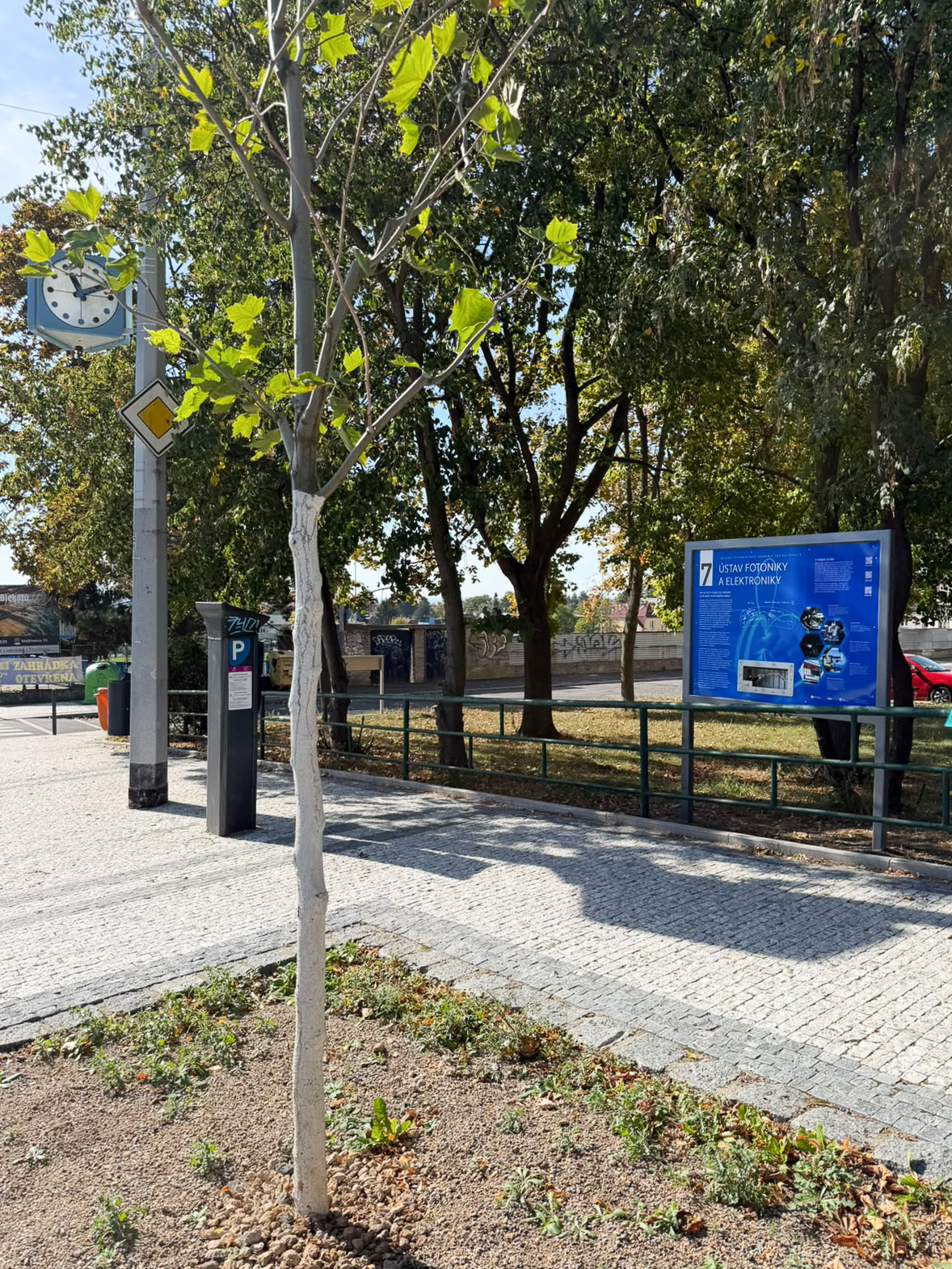
Where to find the ÚFE exhibit (stop No. 7)


Photogalery


We would like to thank the Czech Academy of Sciences (CAS) for its financial support of the nature trail exhibit.
We would like to thank the CAS and the IOCB Foundation for their financial support of the informational signs.